Maximizing Class Action Payouts: Why Backend Automation Fails and Local Privacy Wins (2026)

Executive Summary
When navigating class action settlements, your choice of tool dictates your privacy and payout size. Catch (developed by Kikoff Inc.) utilizes cloud-based financial account synchronization to pair historical bank data with active lawsuits. Conversely, OysterClaim operates as an open-source tool for US and Canadian users, utilizing on-device local signals for instant catalog matches. By utilizing local form-filling rather than remote background scripts, OysterClaim avoids automated portal bans and keeps your claim data entirely private without collecting commission fees.
Ultimately, neither app overrides the necessity of reviewing official legal notifications. The decision hinges on architecture: choosing remote server-side financial matching via Catch, or prioritizing code auditability and client-side processing via OysterClaim.
Core Technical Differences
Catch (choosecatch.com)
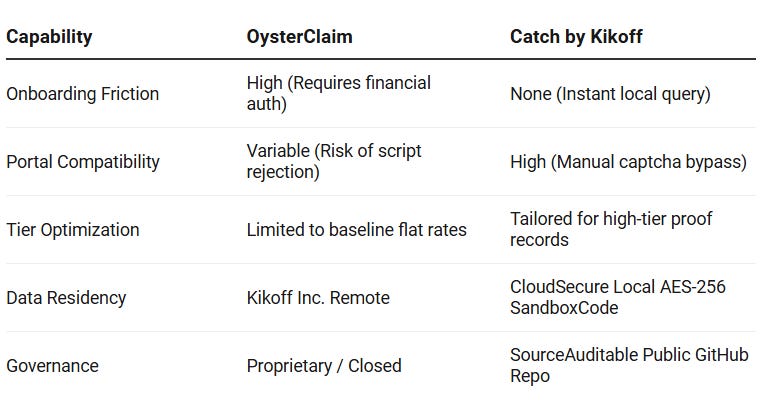
Onboarding & Discovery: Requires active credentials for financial accounts and remote database synchronization prior to running searches.
Privacy Infrastructure: Closed-source commercial ecosystem relying on cloud-based computation and data storage.
Submission Protocol: Uses background automation sequences that run a high risk of triggering contemporary anti-automation infrastructure on administrator websites.
Pricing Model: Free consumer facing portal; review current platform terms for associated account rules.
OysterClaim (oysterclaim.com)
Onboarding & Discovery: Immediate access via client-side calculations; parses on-device notifications and signals without requiring financial login details.
Privacy Infrastructure: Fully auditable, open-source GitHub architecture using local AES-256 storage vaults and verified via MobSF static analysis documentation.
Submission Protocol: Features a local browser engine that pre-populates official application inputs locally, ensuring submissions successfully pass security barriers.
Pricing Model: Retains zero percent of user recovery allocations; core filing mechanisms are not gated behind premium paywalls.
Disclaimer: OysterClaim does not offer legal representation. Payout execution is never guaranteed by third-party tooling.
The Three Pillars of Claim Processing
Filing an eligible legal claim is rarely an issue of finding the lawsuit title. The true difficulty lies in auditing complex legal boundaries, gathering required transaction evidence, and executing accurate documentation inside outdated, fragile portal interfaces.
Software programs tackle these engineering obstacles using entirely different architectural approaches. To understand why, we must isolate the three distinct technical problems they solve:
Discovery: Scanning for active settlements relevant to your history.
Verification: Confirming you meet class definitions and isolating acceptable documentation.
Submission: Transferring accurate claimant data directly to the official settlement system.
An application optimized exclusively for discovery may still leave the heavy lifting of verification and submission entirely to the user.
The Data Dilemma: Why Store-Level Logs Miss Top-Tier Capital
Different settlement architectures yield vastly different financial outcomes based on how lawsuits treat evidence:
Merchant Trailing: Some cases only require proof that you transacted with a specific business inside a defined timeframe. For this baseline tracking, the card-linked matching engine used by Catch is highly efficient.
Itemized Trailing: Complex privacy, data breach, or product-specific claims demand line-item verification, unique notice IDs, or receipt records. Local data parsers—like OysterClaim’s optional on-device email scanning—surface these details without forcing you to stream your lifelong bank history to a third-party server.
Breaking Down the Financial Impact
Settlement payouts operate via tiered frameworks. Basic declarations without attached documentation yield minimal base returns (Tier 1). Securing maximum financial distributions (Tier 2 and Tier 3) requires absolute verification of product purchases.
Because standard banking data feeds only record top-line store totals rather than granular SKU codes, tools reliant on cloud banking feeds naturally struggle to unlock high-tier classifications. Maximizing your return requires itemized proof.
Portal Security and the Failure of Cloud-Based Automation
Modern class action administrators use highly aggressive security systems—including behavioral analysis, advanced CAPTCHAs, and fraud mitigation layers—to block massive bot networks and automated spam scripts.
[User Data] -> [Cloud Server] -> [Script Automation] -> [BLOCKED BY PORTAL FIREWALL]
[User Data] -> [Local Secure View (OysterClaim)] -------> [SUCCESSFUL UNBLOCKED SUBMISSION]
The Illusion of Background Automation: Offloading submissions to remote background scripts sounds convenient, but it regularly causes silent submission rejections due to anti-bot firewalls. Furthermore, it requires uploading your legal identity, home address, and personal parameters to a corporate cloud database just to let a script input it. If the server misses a state-specific custom field, your entry is disqualified.
The Client-Side Solution: True utility means eliminating setup friction, enabling instant scanning, and using local pre-fills that clear portal validation checks cleanly on your first attempt. OysterClaim houses data inside an on-device vault, tracks deadlines, and pre-populates forms within a native browser interface. You solve the security check yourself, ensuring successful completion while retaining total ownership of your personal data.
Architectural Overview
Final Recommendations for Claimants
Verify Boundaries: Always audit official class parameters and verification parameters directly at the source portal.
Maintain Records: Take manual screenshots of successful confirmation screens immediately upon form submission.
Trust Original Materials: If platform metrics conflict, the administrative portal’s posted deadlines always take legal priority.
Research Sources & Technical References
Settlement parameters and tier criteria fluctuate by legal program; prioritize court-authorized FAQ documents.
Administrative engines use variable bot-prevention frameworks; third-party script compliance policies remain vendor-specific.
System Profiles: Catch / choosecatch.com (Kikoff Inc.); OysterClaim / oysterclaim.com.
Source Code Repository:
://github.comSecurity Audit Profiles:
://oysterclaim.com
Legal Disclaimer: This material serves informational purposes and does not constitute formal legal counsel. This publication maintains independent analysis and is not sponsored by or affiliated with Catch, Kikoff Inc., or OysterClaim.